
The Local newsletter is your free, daily guide to life in Colorado. For locals, by locals.
About 80 people gathered at the Denver Indian Center in Westwood on Wednesday night to welcome the seventh-annual Medicine Wheel Ride, a cross-country motorcycle journey by Indigenous women whose loved ones were murdered, became victims of human trafficking, or otherwise disappeared without explanation. Collectively, this group is known as missing and murdered Indigenous relatives (MMIR).
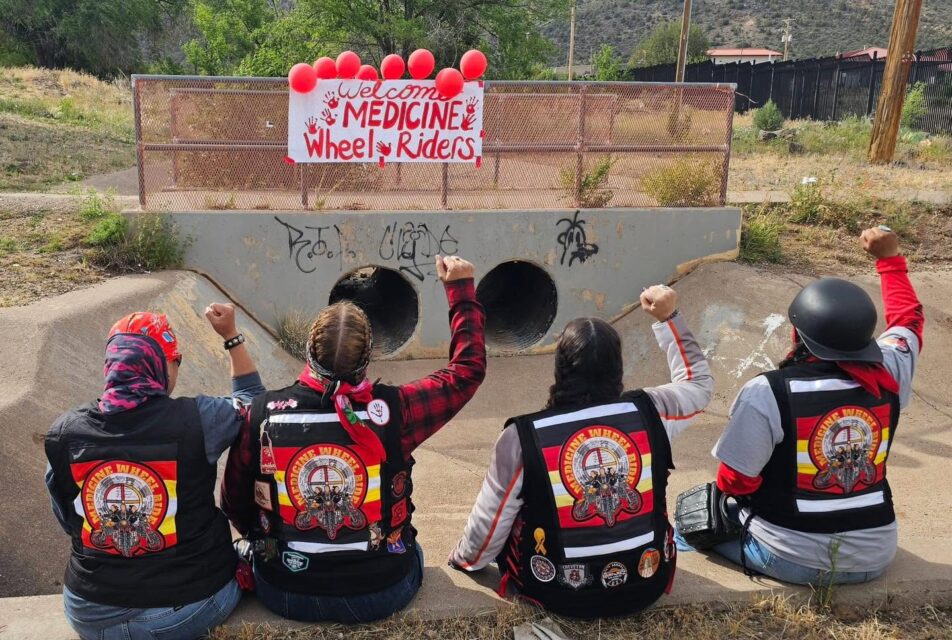
The rumble of Harley Davidsons announced the arrival of the bikers, 15 or so women who are road-tripping from Los Angeles to Sturgis, South Dakota, where the nation’s largest motorcycle rally takes place every August. Tied to their bikes are dozens of red ribbons bearing the names of men and women lost to the crisis nationwide.
Over a meal of fry bread tacos from Berkeley Indigenous restaurant Tocabe, friends and family, community members, and advocates—many wearing beaded jewelry and T-shirts with the red handprint logo that serves as the symbol of the crisis—listened as the relatives of victims, one by one, stood before the crowd to share memories of their loved ones and call for change. Some wept and embraced; one woman carried a smoking stick of ceremonial sage, offering ritual cleansing to the speakers as they returned to their seats.
Native Americans experience violent crime at rates much higher than the national average. Homicide was the fourth leading cause of death for Indigenous men ages one to 44, and the sixth leading cause of death for women, in 2023, according to the Bureau of Indian Affairs. More than 84 percent of Native American women suffer from some form of violence in their lifetime, and the number is even higher for people who are Two-Spirit, an identity that sometimes overlaps with being LGBTQ. In contrast, 47 percent of white women experience violence.
Roxane Frost, a Southern Ute tribe member who drove from her home in Durango for the event, showed a photo of her sister Bernadine Frost, who was murdered by an abusive boyfriend in 1999. “She was only 30 years old,” said Roxane. “It took our family 14 years to get justice.”
Roxane described how her sister was found dead in a snow-covered alley in Longmont. Her killer, Abel Lujan, staged the scene to look like an accident, leaving a beer bottle in her hand; police initially ruled that the death was not suspicious, before an autopsy found that Bernadine had been strangled. Lujan was not convicted until 2013. “They swept us under the rug,” Roxane said.
Roxane also lost two cousins to homicide: one in 1995 and another in 2007. She recounted nearly becoming a victim herself in 2011, fleeing on foot from an abusive partner after he assaulted her. “He broke my jaw—he broke my ribs and left me for dead,” she said.
Raven Payment and Daisy Bluestar, volunteer members of a nonprofit called the MMIR Task Force of Colorado, were among those who pushed for the legislature to mandate creating an alert system in 2022. It’s now mandatory for the Colorado Bureau of Investigation to issue a Missing Indigenous Person Alert every time someone goes missing. Payment, Bluestar, and their fellow task force volunteers also helped pass the law that created an MMIR office within Colorado’s Department of Public Safety, including a 24-7 phone hotline for families. Payment said that these were hard-fought achievements.
“When we initially approached the Department of Public Safety and Colorado Bureau of Investigation, their words verbatim were that they didn’t see the need, and that it would water down the effectiveness of their resources to establish an alert specifically for Indigenous people,” Payment said. “Since that time, more than one Native person a week has gone missing in Colorado.”
In 2025, at least 67 Indigenous Coloradans went missing—the highest number since the state’s Missing Indigenous Person Alert system was created in 2022. So far in 2026, 55 alerts have been issued, according to DPS investigative analyst Katelyn Jenkin. If the same rate of reports continues, that means 2026 could be on pace to have roughly 91 missing Indigenous Coloradans.
High rates of domestic violence, generational trauma, poverty, addiction, and human trafficking are a few of the contributing factors to the crisis. Missing Indigenous people also often get lost between bureaucracies, Payment said. It can be unclear whether a crime falls under the jurisdiction of tribal, state, or federal police, and the various legal entities don’t always communicate. The MMIR Task Force has helped to lead training sessions for police officers across the state.
Native Americans are also more likely to become victims of police brutality than any other demographic, Payment said. Indigenous women are 38 times more likely to be affected by police brutality than white women, according to a 2019 study, and Indigenous men are 14 times more likely to be victims than are white men. Among the speakers at the event was Lynn Eagle Feather. In 2015, she called the Denver Police Department when her son Paul Castaway, who suffered from schizophrenia, was having a mental health crisis; an officer fatally shot him. Lynn is helping to raise Paul’s young son, who was three when his father died. “He still misses his dad, and we talk about him all the time,” she said through tears.
The Wednesday night event included a screening of We Ride For Her, a short documentary about the Medicine Wheel Ride by filmmakers Prairie Rose Seminole and Katrina Lillian Sorrentino. They are now at work on a feature-length film about the ride.
After the film, members of the Denver dance group Indigenous Corporation 5280 performed for the crowd in traditional regalia. The sounds of jingle dresses, drumming, and singing echoed through the gymnasium, where colorful flags representing many tribal nations, including Colorado’s Southern Ute and Ute Mountain Ute tribes, decorated the walls.
Roxanne Frost, who opened the evening by giving a prayer, said that telling her family’s story before the group had made her a little nervous, but also helped her feel less alone in her grief. “It’s been a long road, but I’m healing,” she said.