

The Local newsletter is your free, daily guide to life in Colorado. For locals, by locals.
Windows on cabins near Platoro Reservoir are boarded shut against the threat of snow, which typically piles up against their northern walls well into summer at 10,000 feet in the San Juan Mountains. But on a recent May morning, as Nathan Coombs hefts a metal pan about four feet in diameter onto a stand, the shutters face only dry, brown grass.
The manager of the Conejos Water Conservancy District, which delivers water from the reservoir to San Luis Valley farmers via its namesake waterway, is monitoring the evaporation station to measure how much of Platoro’s water is being lost to the thirsty sky. The bone-dry interior of the pan is ringed with white lines from past years’ experiments. “That looks like some pretty heavy evaporation,” teases Kevin Terry, the program director for Trout Unlimited’s southwest region. Coombs chuckles, turns on a spigot, and replenishes the empty pan. The process looks about as sophisticated as filling a backyard birdbath.

The low-tech equipment supplies numbers for some complicated math. Evaporation rates play a part in how much water he’s allowed to release for irrigation in the San Luis Valley. It’s just one more way the West is losing water in an increasingly parched system.
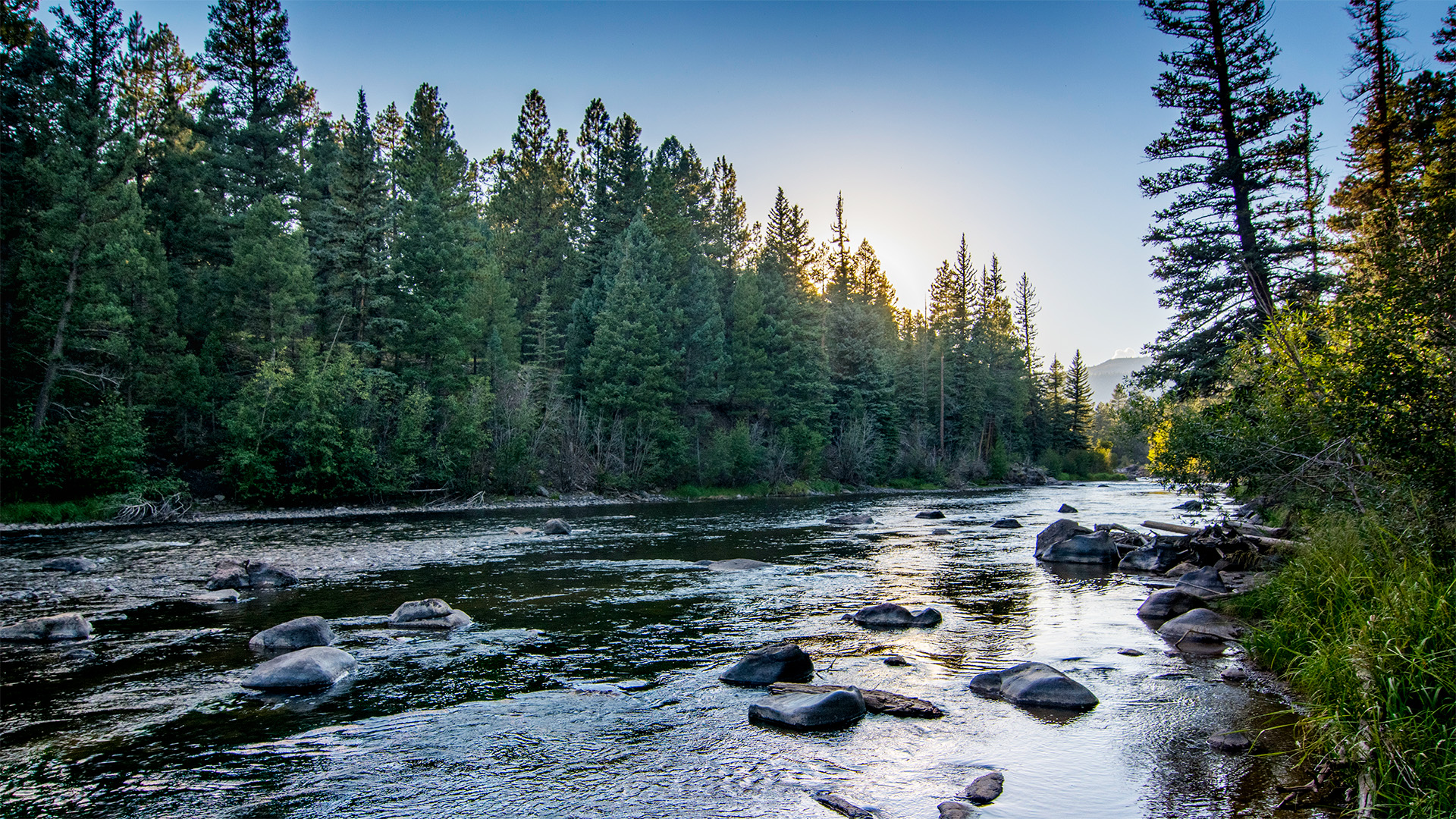
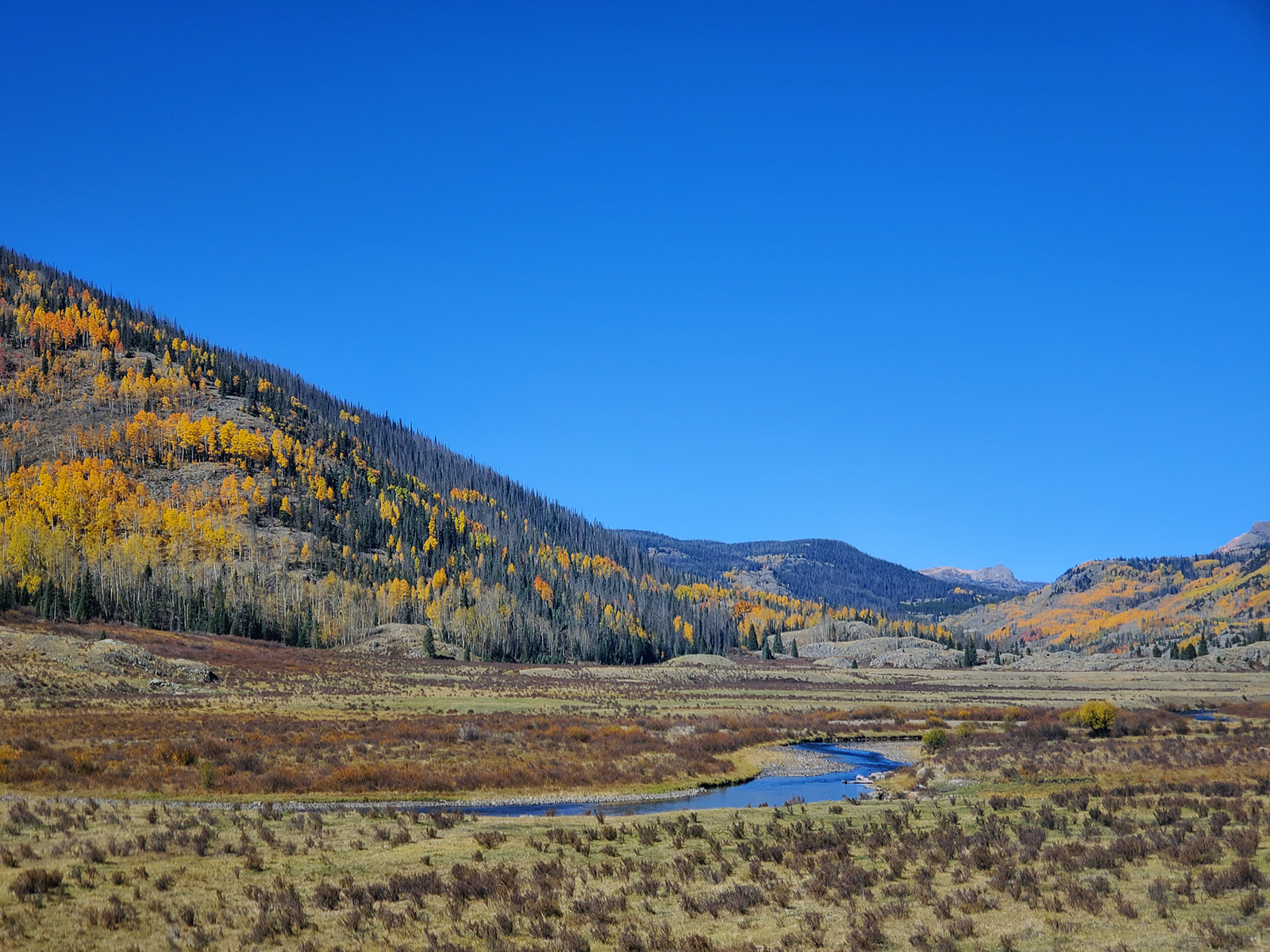
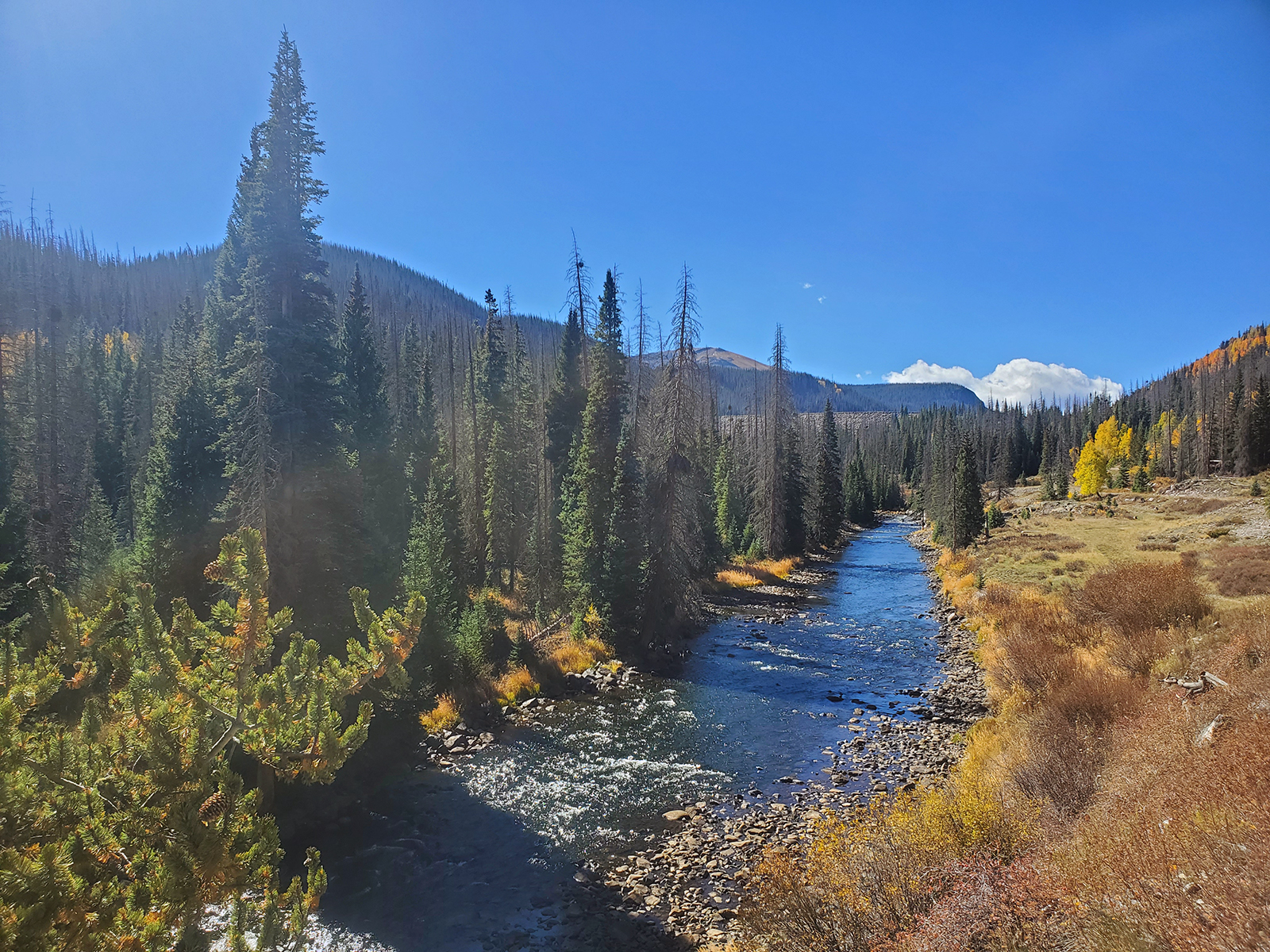
The Conejos runs out of the eastern San Juans, beginning as high mountain streams that curl around the peak that shares its name before dropping through valleys notched between steep, conifer-covered slopes. The river pools into Platoro, a flatwater fishing destination, then pours through riffles piled up between rock-bottomed curves. Campgrounds, picnic tables, and trailheads line the riverbanks. Some families save all year for a trip to cast after the waterway’s brown and rainbow trout. Terry has been fishing here since he was a kid, when his father started driving him up from Taos, New Mexico. He knows where brown trout will roil the surface, lunging after hatching insects as well as cast flies.
But about midway on its run to join the Rio Grande near the state line, the Conejos shifts from play to work. There, it winds among fields of potatoes, alfalfa, hay, barley, and wheat that could not exist in the high desert scrubland without it. Agriculture is the economic bedrock of the San Luis Valley, where about 46,000 people live in towns scattered among green fields. A tractor on the highway passes for a traffic jam.
For decades, fishing and farming worked synchronously, as water owed to farmers just happened to support trout habitat on its way down the Conejos. Now, both are struggling to survive. A study published late last year in the scientific journal Discover Water found that reservoirs, aquifers, and annual stream flows in the Rio Grande Basin, which includes the Conejos, are all dropping, with only half of water consumed being renewed. Since 2000, snowmelt in the Rio Grande’s headwaters has run 17 percent below what was seen in the past century, and climate scientists forecast further declines of up to 28 percent in the coming decades.
Throughout the West, water managers are reckoning with this worsening crisis. Along the Colorado River, which supports 40 million people and 5.5 million acres of cropland, dwindling supplies have led to a multiyear feud among the seven states that rely on the waterway. No one can agree who should make the deepest cuts amid systemic use that’s visibly unsustainable. The federal Bureau of Reclamation is threatening to step in and dictate reductions if states cannot work through the impasse. Those governments, meanwhile, are stockpiling funds for what now seem like inevitable legal battles in the U.S. Supreme Court.
In the San Luis Valley, however, farmers and anglers, folks with seemingly different priorities, have crafted some collaborative and creative approaches to keep the river flowing. For a while, at least, the innovations seemed to appease everyone. Then this winter happened.
Read More: The Search for Solutions to Colorado’s Water Crisis
There’s little doubt about where Terry’s passion lies: The New Mexico native and lifelong angler beams when he talks about the way the light catches on the red slashes of a Rio Grande cutthroat trout he’s reeled in high in Colorado’s mountains. In 2013, the fish biologist joined Trout Unlimited, which sent him to the Rio Grande Basin with an ambiguous and ambitious directive: “Do good things with water.”
Terry, now 45, started by learning about what he calls “the plumbing”: the system of rivers, reservoirs, canals, and even centuries-old acequias dug by Spanish settlers in the San Luis Valley. He also studied the water rights and laws governing where and when water is diverted, used, stored, and transferred. He attended meetings around the valley, driving up in his Trout Unlimited–branded Prius and often wearing hoodies and ballcaps. At one such gathering, a state-supported forum called the Rio Grande Basin Roundtable, he sat across from Coombs. Like a lot of people in the San Luis Valley, Coombs, a fourth-generation farmer who grows alfalfa and raises cows, was skeptical of a newcomer who might make requests without realizing the sacrifices already built into the water system. “Huh, nice to meet you, Kevin—don’t know what your last name is, but I don’t need to know,” Coombs says jokingly about their first interaction.
But soon after that meeting, Terry went to Coombs with a question: “How come we’re supposed to get more water out than naturally exists?” The previously prickly Coombs, Terry remembers, suddenly softened. This outsider understood the problem.
In many of Colorado’s rivers, all (or more) of the water flowing downstream has been promised to farms, cities, and industries. States are legally owed water, too, and the 88-year-old Rio Grande Compact outlines how Colorado, New Mexico, and Texas will split the river. Depending on how much water hits stream gauges along the Rio Grande and its tributaries, Colorado usually sends anywhere from 35 percent to 70 percent downstream. “It’s not a question of whether we will or won’t pay the compact,” Coombs says. “It’s whether we will or won’t irrigate with our farmers.”
Locals are leery of outsiders partly because of how the compact rolled out. Before states signed it in 1938, farmers along the Conejos were told that what naturally spilled off their fields after flood irrigation would fulfill the compact. Their rights would never be limited. Then Colorado ran up so much debt to downstream users on the Rio Grande that from immediately following Platoro’s completion in the early 1950s until massive snowfall in the early 1980s, the reservoir wasn’t allowed to fill. The water was owed downstream. “That disgruntled a lot of old farmers,” Coombs says. “We began this basically confrontational attitude.”
The Conejos Water Conservancy District later tried to buy the reservoir, in the late 1980s, but the deal fell apart after the district felt the federal agencies that controlled Platoro made unreasonable demands. Among the conditions for the purchase: The conservancy would have to release more water into the river in winter than naturally flows into the reservoir. “They felt like they got stabbed in the back,” Coombs says. “It left a really sour taste in the board’s mouth.… We basically slammed the door on anybody.” Today, the Bureau of Reclamation still owns the reservoir.
In 2018, after a dismal winter deprived the San Juan Mountains of snowpack, it became clear that the isolationist approach wasn’t working. For most of August, the Conejos dwindled to a trickle, with trout stranded and dying in disconnected puddles. A lot of anglers, including Terry, watched fish float belly-up to the surface after running out of oxygen or overheating in shallow standing water. Farms suffered, too, with parched crops. Terry wanted to do something—something good with water—so that when the next dry year came, they wouldn’t just be standing around, watching the river die.
Winter is “puzzle season” in Terry’s family: a time to break out a box of pieces and take turns finding where they fit to make the picture whole. Making water rights work, he’s discovered, requires the same set of skills.
In 2014, Terry had piloted an initiative to increase the flows on the Conejos River in winter, when farmers don’t call for water (they have no crops to irrigate) and, as a result, fish suffer (they freeze in shallow creeks). It turned out that there are plenty of other justifications for moving water when fields are fallow. Terry, for example, simply asked Heather Dutton, the general manager of the San Luis Valley Water Conservancy District, what flexibility she had in when and how quickly she released water to replenish streams affected by groundwater wells.
Dutton determined she could contribute about 200 acre feet from January to March. She wasn’t the only water manager Terry collaborated with. Through what Dutton calls “spreadsheet heroics,” various users spread releases for a multitude of reasons. On the Conejos, winter flows climbed from roughly one cubic foot per second to five, and then 10 and above.
Fixing summer flows would require building an even larger coalition. Before Terry, farmers often bundled their requests for releases together, because more water moving downriver meant losing less of it along the way. (When the river is low, as much as 30 to 35 percent can vanish before reaching a farm.) They’d also call for water early in the growing season when the channel was fuller, again hoping to squeeze every drop.
After spring, flows in the Conejos would taper over the summer; farmers might want water in the dog days of August, but too much would be lost along the way to thirsty trees, dry ground, and evaporation. During the 2018 drought, when the Conejos headwaters registered somewhere between zero and 30 percent of average snowpack in April, there wasn’t much water to ask for anyway. By August, no farmers were calling for water. Crops and fish both suffered.
With winter 2024-’25 looking like a repeat of seven years earlier, Terry set out to see whether he could keep the river flowing by asking farmers to wait to call for some of their water in August. But this time, he offered a bounty: up to $10 per acre foot for any water requested that month, with a cap of $290 per day for all rights holders who called on a specific day. (This served as a subtle incentive to spread releases out. Instead of Farmer Bob and Farmer Larry both watering on August 5, one takes the next day so they don’t have to split the $290.) No contracts, no changes to their farming. Thirty-two farmers said yes.
Coombs bolstered the plan with 18,000 acre feet he’d banked in Platoro Reservoir in 2023, the last good snow year. Trout Unlimited provided staff and the incentive money. And Terry mediated with Colorado Parks and Wildlife to align some of the agency’s water rights with farmers’ releases—a partnership that, given the Conejos conservancy district’s historical grudges against government agencies, made some nervous. “When he brought CPW water in,” Coombs says, “my board was like, ‘It’s still a little itchy, but OK, we’ll try it.’ Then it worked out fantastic.”
In August 2025, the Farms and Fish Flow Program kept the Conejos wet over 20 days that would have run dry under natural conditions in 2018—and for just $10,000. “It sounds easy, it sounds logical, but it had never been done before,” says Ryan Unterreiner, southwest region water resources specialist with CPW. “It took coordination, meetings, support from the water commissioner and the division engineer and the water users, and some trust, of course.” Essentially, 250 acre feet from CPW supported farms releasing 2,350 acre feet.
“It was a win-win, by far, and I can’t imagine anyone saying that it wasn’t,” says Jim Paine, a hay farmer and cattle rancher in Conejos County who, along with his son, participated in the program. In the end, he got a little extra money and a little extra water. And, he says, “it obviously helped the trout some, I hope.”
Terry is not without his critics. There’s one guy, he says, who shows up at every meeting with demands for when and how much water will move downstream that, as Terry sees it, are based on old and outdated promises. “We tried so hard to educate him, just like I got educated, and be like, This is how it works—like, do the math, dude,” Terry says. “And all he does is say the same thing at every meeting and just sets those water users off.”
That one person’s complaints, Terry says, have stoked farmers’ fears that environmental groups like Trout Unlimited are trying to take their water, which has contributed to the continued delay of a winter flows program for another San Luis Valley reservoir, Rio Grande. There, water levels drop to less than one cubic foot per second between November and March.
This naysayer isn’t Terry and Coombs’ biggest problem, however. In May of this year, the Conejos was riddled with signs of the winter that wasn’t. Although the river brimmed at its banks, in a typical year it would flood the valley, glistening among clumped wetland grasses and willows. Runoff peaked at about 1,000 cubic feet per second, well below the typical 2,300. Platoro Reservoir itself was only 44 percent full.
“Climate change seems to be accelerating the decline in inputs: snowmelt runoff,” says Brian Richter, president of Sustainable Waters, a national organization focused on water scarcity. “It just gets to be a dangerously challenging situation.”
The Conejos Water Conservancy District board initially allocated 6,500 acre feet of water to Farms and Fish but withdrew it in April. Coombs recommended against running the program at all. The volume wasn’t enough to make a difference for farmers. “Do you put new tires on a wrecked truck?” he says. “We are shocked about how bad this year is, but nobody is shocked about what it’s going to take to deal with it. We, unfortunately, have some practice.”
Farmers along the Conejos may face near-total losses. Many won’t even plant, and what goes in the ground may not survive. In addition to operational costs, a groundwater replenishment fee levied by the state adds $500 per acre foot to well water. Terry’s done this enough to run the math in his head. A potato farmer who has no water coming from the river will need 240 acre feet of well water—$120,000 per irrigation circle, at $500 an acre foot—and a farmer might run three to five circles. “So they’re gonna go half a million dollars in debt on fees and hope that that potato makes it to market and covers it,” Terry says. In a good year, farmers in the San Luis Valley could gross $1 million from a single circle at market. In a drought year like this, Coombs says, they will be lucky to see half that.
“The really hard truth, the thing we don’t like to say out loud, is there will be fewer irrigated acres in this valley,” says Dutton of the San Luis Valley Water Conservancy District. She’s working with the Rye Resurgence Project to encourage customers to switch to drought-resistant crops, such as rye, quinoa, millet, and beans. “People on the Colorado [River] are saying, ‘We can’t cut back,’ and it’s like, Well, we thought that, too,” Dutton says.
Local fly-fishing and rafting guides will also have to cut back on trips. After checking the evaporation station at Platoro, Coombs drives by a high-end fly-fishing and horseback riding ranch on the way home. Terry looks out the truck window at the log-framed gate. “They’re going to have a rough year,” he says. “Tight margins in that industry, too.”
Sure enough, just before the Fourth of July, CPW issued a voluntary fishing closure for afternoons on the Conejos River. The agency asked anglers to let cold-water fish rest while they tried to survive in a sunbaked stream that was eclipsing 71 degrees during the hottest hours of the day.
Although Farms and Fish isn’t expected to run this summer, Terry reached out to CPW. Seeing a new willingness to cooperate in the San Luis Valley and having another conservation partner downstream that needed water for big game and water fowl habitat, the agency tapped into a rainy-day fund to offer about 600 acre feet of water for the Conejos. The water will keep the river running at a minimum of five cubic feet per second. That’s far below the 40 recommended for fish, but it’s something.
“We’ve added a new tool, and we want to use that tool as much as we can, but it’s not the last tool we’re going to work on,” Terry says. “We learn from every one of these hard years, and we don’t forget those lessons.”
Read More: How the 100-Year-Old Colorado River Compact Laid the Foundation for the West’s Current Water Crisis