
The Local newsletter is your free, daily guide to life in Colorado. For locals, by locals.
Chances are that if you saw five-year-old Robert Ray walking around his neighborhood on Chicago’s South Side back in 1990, he wasn’t alone. Most days, at least five or six dogs trailed behind him, lured to his side by the black-eyed peas and string beans he snuck from the dinner table when his mom wasn’t looking.
But Ray’s early years were far from idyllic. He was still in kindergarten when he came across a dead body in an alley. Ray flagged down a passing cop to tell him what he saw, and the officer gave him a quarter for his good deed. Later, a gang member in the neighborhood found out about Ray’s disclosure and gave him a dollar bill in exchange for never talking to the police again. “I think about that now,” he says, “like, How did that seal my fate?”

Ray’s family bounced back and forth between Chicago and Denver, but illegal drugs, gun violence, and economic hardship always followed. “I never wanted to sell dope,” Ray says. “I wanted to be a veterinarian.” But days before his 10th birthday, Ray accidentally shot himself in the stomach with his brother’s handgun when he was doing his best impression of a cowboy. By 16, he was selling cocaine at the bus stop near his home in Aurora so he could buy a car. At 19, he was involved in a deadly shooting in Aurora’s Lowry Park. Four years later, in 2009, he was sentenced to death for orchestrating the murders of Javad Marshall-Fields (who was set to be a witness in the Lowry Park trial) and his fiancée, Vivian Wolfe.
Ray sat on death row for 11 years, spending 23 hours a day in his cell. By 2015, the near-constant isolation had worn him down to the point that lethal injection sounded like a welcome reprieve. “My lawyers were doing everything in their power [to give me reasons to live], because I wanted to waive my appeals so I could speed up my death,” he says.
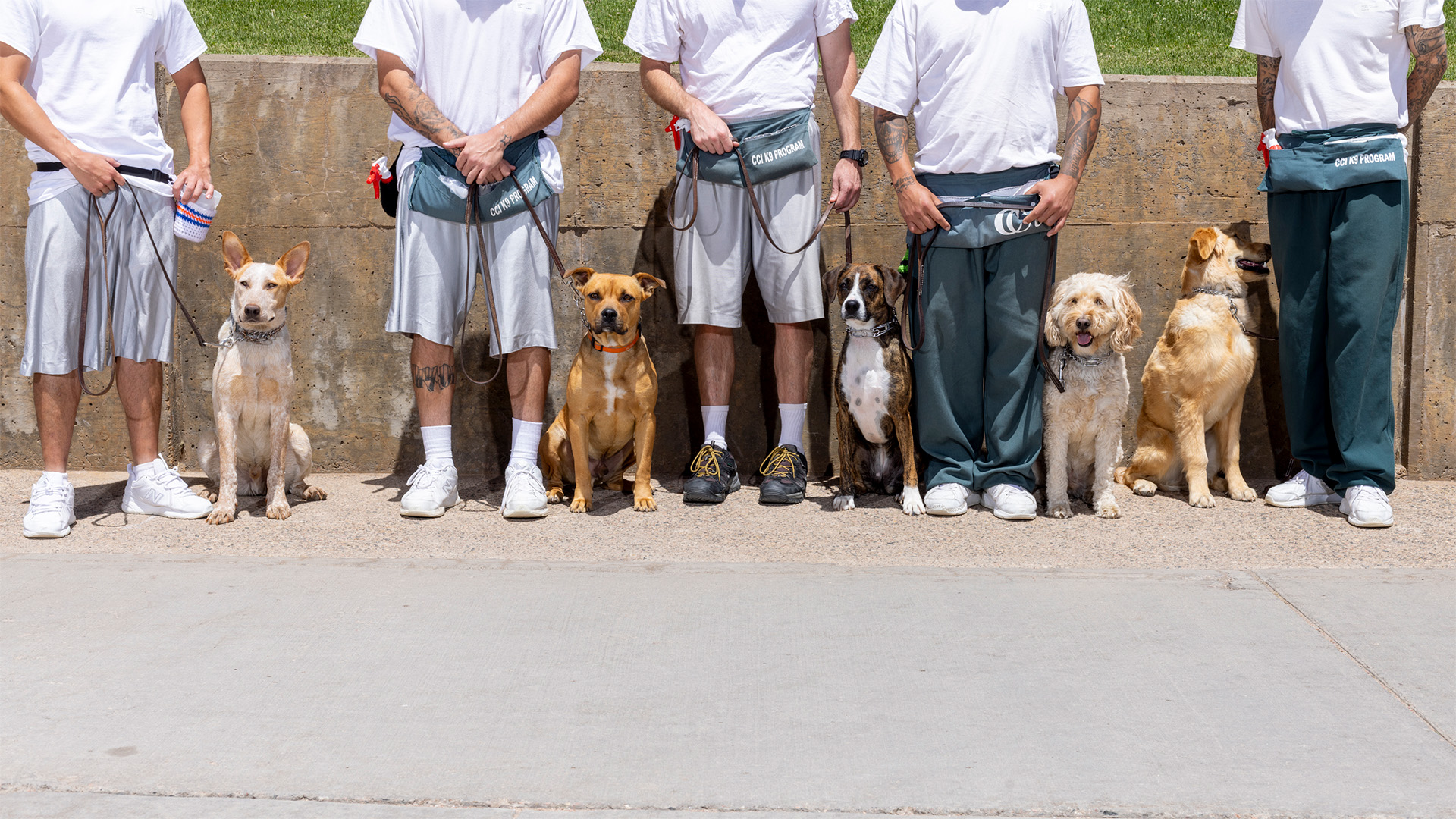
To help Ray find purpose, his lawyers enrolled him in college courses and sent him Austrian psychiatrist Viktor Frankl’s 1946 memoir Man’s Search for Meaning, which centers on his time as a prisoner in Nazi concentration camps. Ray started writing children’s books about love, resilience, and acceptance for his daughter. But after Colorado abolished the death penalty in 2020 and the governor commuted Ray’s sentence to life without parole, he was transferred to the Territorial Corrections Facility in Cañon City, where he began teaching dogs obedience through the Prison-Trained K9 Companion Program.
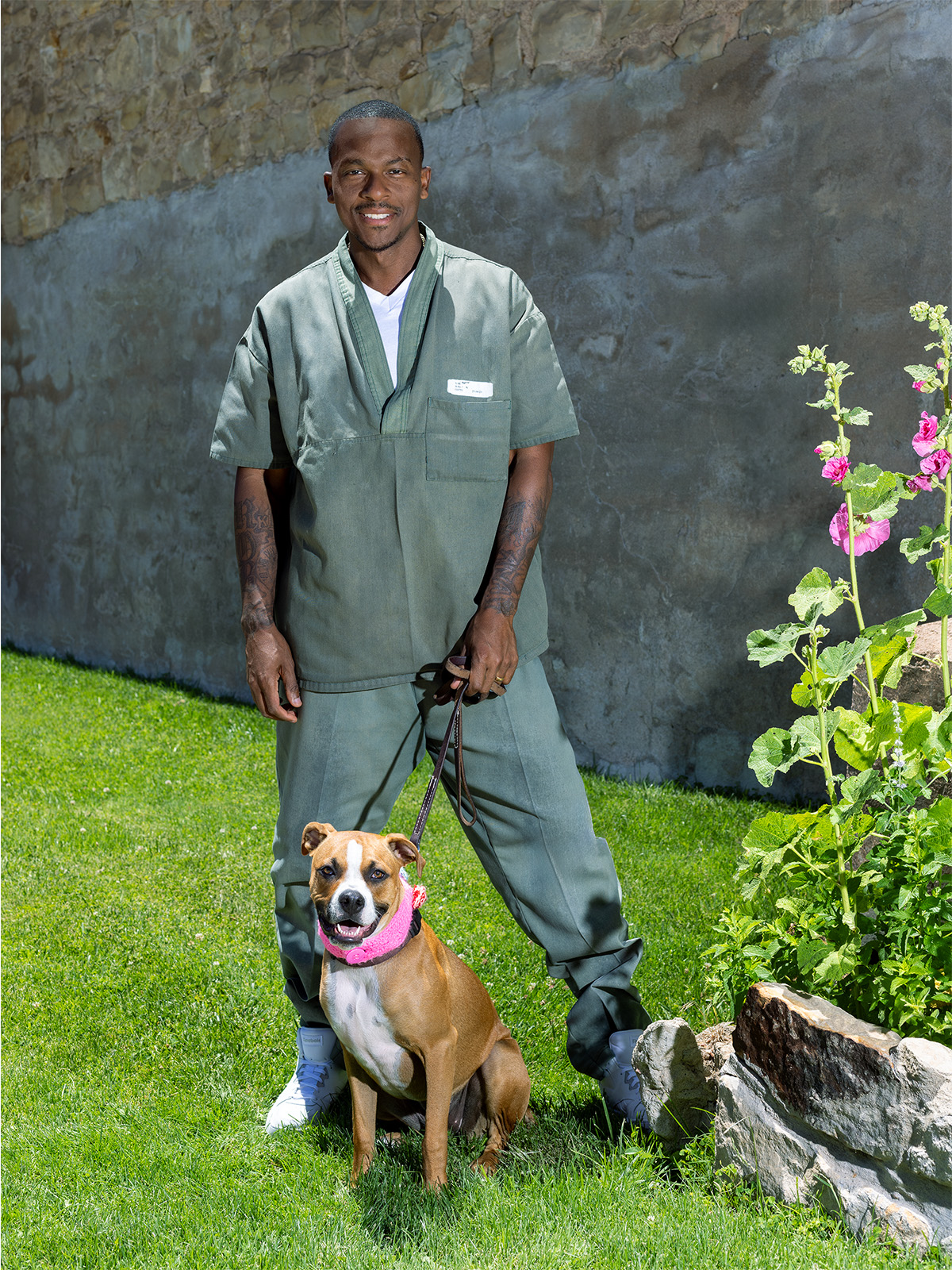
The dogs come from either private owners or shelters that put them up for adoption after their training is complete. For four to eight weeks, the pups stay with Ray and other participating inmates at the prison, where they teach them basic manners—and a few fun tricks. Caleb, a spunky pitbull Ray affectionately refers to as a “street punk,” stretched Ray’s training abilities. “He came in just full of bravado,” Ray says. “He did what he wanted to do.” Still, by the end of his stay, Caleb was a model inmate, even mastering the command “pat down,” where the dog would place his two front paws up on a wall and wait for pets.
Ray’s known around the facility for being able to tame even the unruliest of canines, but that isn’t because he follows the training handbook to a T. In fact, he admits, he broke all the rules with his first trainee, a sweet mixed breed named Rosie. “It’s supposed to be just like a business relationship. No, I don’t do that with none of my dogs,” he says. “I love on ’em all day.” Ray’s training style is one of kisses, hugs, and constant playtime. When Rosie cried in the middle of the night, Ray would sometimes cave and let her sleep in his bed (despite the handbook advising otherwise). He even commissioned another inmate to crochet collars decorated with roses, bows, and faux spikes for each of his canine companions.
Through trial and error, though, Ray has learned that sometimes setting boundaries with his pupils is for their own good. He’s discovered that kennels can be a safe space and roughhousing sometimes leads to aggression. “I’m getting some of my biggest lessons, my biggest aha moments, out of things I’m doing wrong,” Ray says. Dogs like Caleb and Rosie have cultivated Ray’s patience—and shown him that even the unlikeliest characters can change. “I love seeing the transformation from where they were to where they’re at and knowing that I played a part in that,” Ray says.
Over the years, Ray has been transforming right alongside them—from that five-year-old boy confused by the violence around him to a convicted murderer to a man who says he’s trying to make amends. “I want to overspill on the other side of these walls, impact as many lives as I possibly can,” he says. In late June, Ray was transferred to the Arkansas Valley Correctional Facility in Ordway to take on a new mission: being a peer mentor to younger inmates. It’s a bittersweet ending to his involvement in a program that helped him find purpose and a future in life behind bars. “I feel like I’m not running from my past,” Ray says. “I’m using that as a part of my tool to help reach people.”
Read More: Of Canines and Convicts
If you have a pooch in need of basic training, visit cci.colorado.gov/k9 to join the wait list. Due to high demand, it may take up to 12 weeks for a spot to become available. Interested in adopting a prison-trained pup? Fill out an application online. Boarding-in training starts at $1,800; adoptions with training included start at $650.