

The Local newsletter is your free, daily guide to life in Colorado. For locals, by locals.
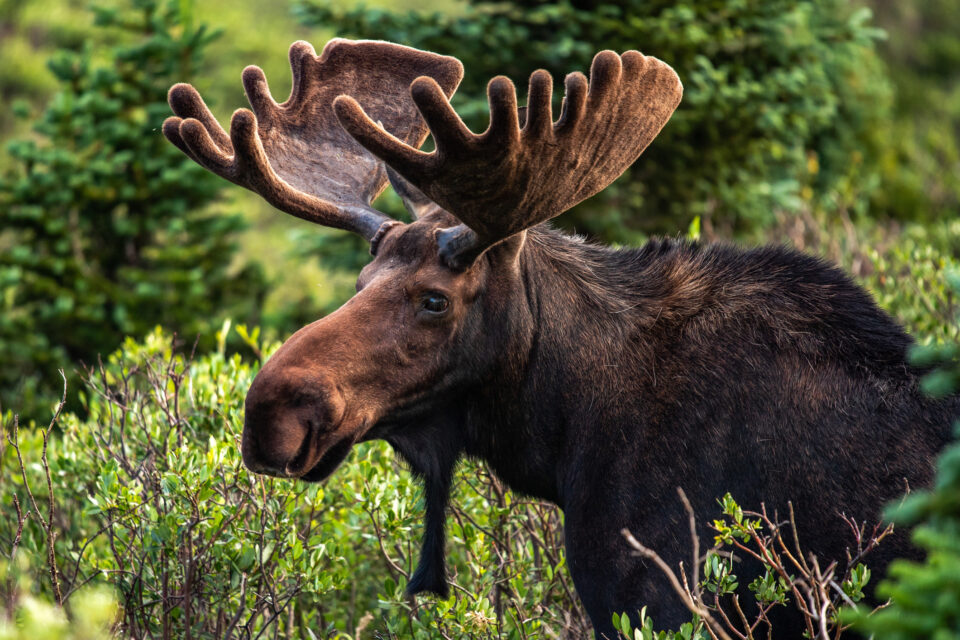
Moose are iconic in Colorado, where approximately 3,500 of the oversize ungulates now roam. But scientists have long believed that the charismatic critters are actually newcomers to the Rockies, with only the occasional transient passing through before Colorado Parks and Wildlife introduced the species in 1978.
A new study led by a University of Colorado Boulder archaeologist may be rewriting that history. Far from being non-native, moose have been clomping around the state for hundreds, possibly thousands, of years, says associate professor and archaeology curator William Taylor. “As far back as we can trace the interactions of people and animals, there were moose in Colorado—and not just a wandering bull moose, but breeding populations,” Taylor says. “The historic record proves that beyond a shadow of a doubt, in my view.”
Taylor and his colleagues didn’t put shovels in the ground for a new dig, but instead analyzed thousands of years of archaeological records, Indigenous accounts, newspaper stories, and other evidence, finding hundreds of mentions of moose in what is now Colorado. “We’ve been combing the rafters of museums across the Southern Rockies and getting into archives, records, and databases,” he says, including a collection of fossilized bones dating back 9,000 years. “It was all pointing in one direction, which is the significant and longstanding presence of moose.”
This research, he argues, was more thorough than that done in the 1970s, when CPW brought moose to Colorado. In 1978, CPW airlifted 24 of the animals from Wyoming and Utah, releasing them to create a breeding population and, eventually, hunting opportunities. “The inference that moose were not established in Colorado seems based on a superficial look at historic records that were published in the 1970s,” Taylor and his co-authors write in the paper, published last month in the Journal of Biogeography. He suspects that moose were breeding in Colorado as far back as 7250 B.C.E. and possibly even 10500 B.C.E. Taylor believes it’s important to correct the record, because native and non-native species are often managed differently.
Hold your hooves, say the wildlife biologists at Rocky Mountain National Park, home to roughly 240 moose. “We think the data presented so far, including in Dr. Taylor’s paper, shows pretty clearly that there isn’t evidence of a sustained breeding population [prior to the ’70s],” says William Deacy, who has a doctorate in wildlife ecology and leads the park’s large mammal ecology team. His colleague Chris Clatterbuck, the natural resources program manager for the park, argues that the newspaper accounts Taylor found only serve to highlight the rarity of moose encounters: “The fact that you’re finding newspaper articles reinforces the notion that it’s a unique, newsworthy event.” Nor are Clatterbuck and Deacy persuaded by the archaeology. “They only found one bone that is conclusively moose, in contrast to the maybe thousands of bison, elk, and deer bones in the archaeological record,” Clatterbuck says.
Taylor’s co-author, New Mexico State University professor John Wendt, fires back: “We identified four Colorado sites with moose or likely moose remains,” and the true number is likely much higher, since moose bones are hard to identify, he writes in an email. As for the newspaper accounts, the research team found at least 30 stories published from 1860 to 1970. “Encounters were certainly newsworthy, as they remain today when moose populations are high, but newsworthiness alone cannot tell you whether an animal was rare,” Wendt says. “It has to be weighed against dates, locations, the descriptions of the animals, and other records, like photographs and agency field notes”—all of which, they believe, come together to prove the longtime presence of moose in Colorado.
Colorado Parks and Wildlife is giving a thumbs-up to the paper. “After reviewing this research, CPW is inclined to believe that moose are a native species to Colorado,” says spokesperson Luke Perkins, who added that the findings won’t change how the state wildlife agency manages moose.
Regardless of whether the research is persuasive, Clatterbuck and Deacy say it wouldn’t change decision-making at the national park, either. “‘Native’ is a mushy term,” Deacy says, “and it doesn’t really inform our management. Whether we label them as native or non-native, our actions will likely be the same, because what matters is what they’re doing on the landscape.”
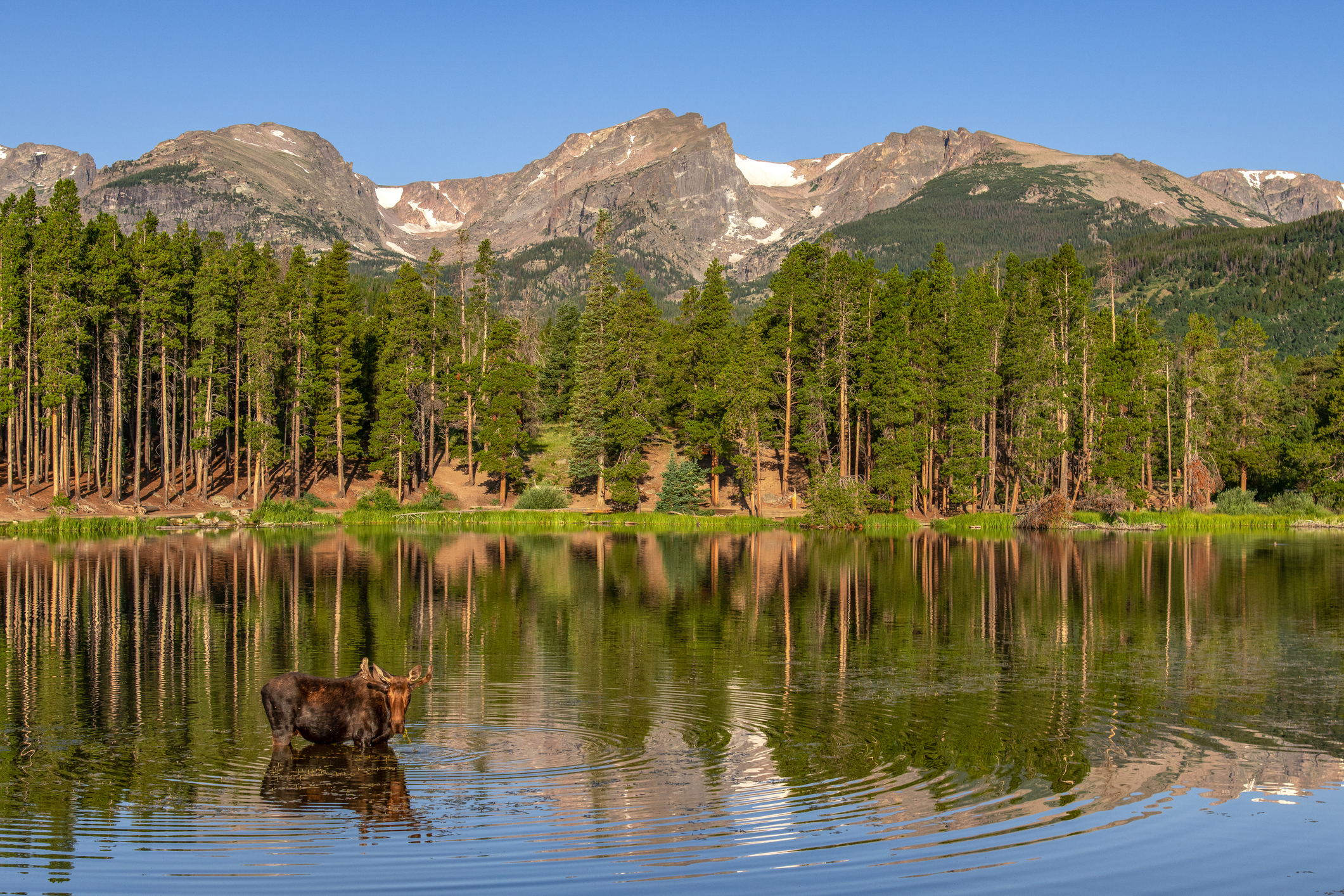
The moose population in Rocky Mountain National Park has ballooned by 50 percent over the last five years to approximately 240 individuals. With few apex predators to keep the population in check, as wolves and grizzly bears do elsewhere in the West, the ungulates are thriving. They have voracious appetites, mowing down acres of tall willow, a vital wetland plant. “One moose is equivalent to 15 elk in terms of how much tall willow it can eat,” Deacy says, “and it’s clear that high densities of moose are strongly associated with declines in wetlands.” When moose eat too much willow, beavers don’t have enough of the plant to eat and build their dams. Fewer dams can lead to fewer acres of wetlands, which are a vital defense against wildfires.
Deacy, Clatterbuck, and their RMNP colleagues are working on a moose management plan, which they expect to publish this winter. The plan won’t include hunting, which is illegal in the park, but it might suggest measures such as birth control, fencing, relocating moose to outside of the park, and potentially even culling—all strategies that have been used with other out-of-control species, such as elk.
They also stressed that they have consulted extensively with Indigenous Coloradans—something that Taylor’s paper calls for more of. “Those conversations are often confidential, but we take them seriously. We’re disappointed at how that was portrayed in the paper,” Clatterbuck says.
Is it really true that an animal’s native status has no impact on its management? Taylor isn’t buying it. “Look at what the Park Service has done in similar conflicts,” he says, such as in Olympic National Park, where non-native mountain goats were removed. “I am glad to hear that the native/non-native distinction won’t factor into the park’s management choices, but as an outside observer, it usually is a term that carries a fair amount of weight.” Colorado has a long history of restoring native wildlife, including wolves, lynx, ferrets, and river otters, among other species.
Wendt points to the National Park Service’s formal management policies, which spell out different criteria for native vs. non-native wildlife. “Native populations are generally governed by natural processes, with intervention allowed under specified conditions,” Wendt says, “while non-native species may be controlled, up to and including eradication” if the species is causing harm.
Deacy and his colleagues stress that while they won’t rule out the possibility of culling, there are no plans to fully eliminate moose from the park. “No one has used the term ‘eradicate’ or ‘exterminate’ or anything like that,” Deacy says. The park staff know visitors love seeing and photographing moose, and they take that into account. “I don’t want to come across as demonizing moose,” Clatterbuck says. “But there’s no population control, and things are out of balance.”