
The Local newsletter is your free, daily guide to life in Colorado. For locals, by locals.
The ways in which Yasu and Toshi Kizaki have fundamentally shaped Denver’s dining scene are incalculable. Largely credited with introducing the city to Japanese cuisine upon the opening of Sushi Den in 1984, the natives of Tamana, on Japan’s southern Kyushu Island, were the first locally, and among the first in the United States, to source seafood directly from Japan—some of which they were also dry-aging many years before the tradition became a showy stateside trend.
They’ve also trained countless chefs over the decades while expanding the Den Corner restaurant group to include Izakaya Den and Ototo. (Toshi also operates his own Michelin-starred omakase counter, Kizaki, down the street.) But the brothers’ impact may never be fully publicized: Now in their early 70s, they’re eternal wellsprings of innovative ideas and insights that often remain behind the scenes.
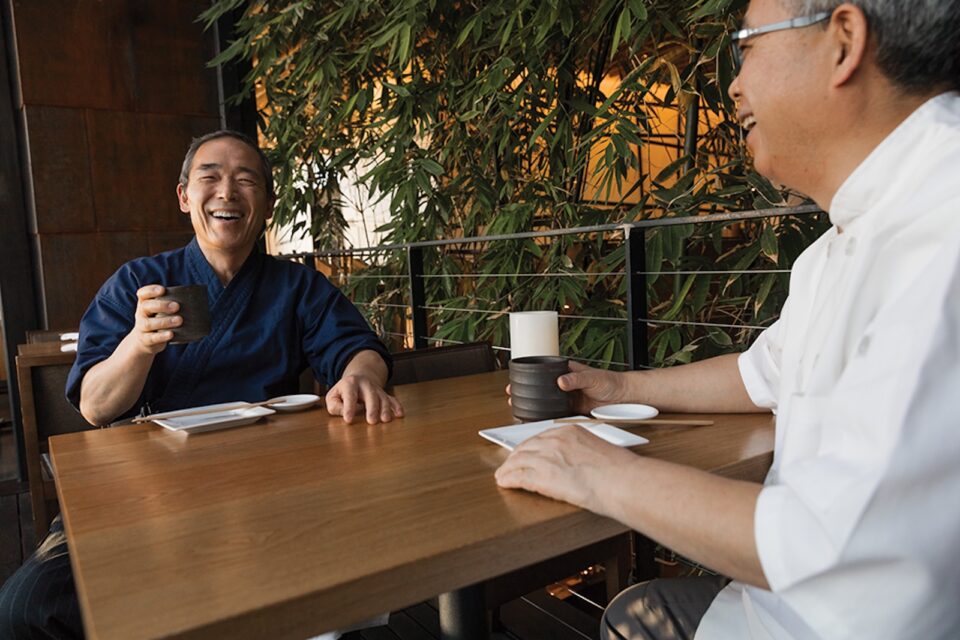
I recently joined Yasu in Sushi Den’s private dining room to discuss just one example: the organic rice that they’ve spent the past couple of years going great lengths to source from Japan. Over the course of an hour, he taught me more about the history of both his homeland and his family than I could possibly recount here.
The cultural lesson started with the fact that, until 1868 when the Tokugawa shogunate collapsed, the Kizakis’ ancestors were samurai. The remaining tangible evidence is “a small, rusty sword passed on for generations,” Yasu says. “Why small? Why rusty? When the Second World War ended, we all had to submit our samurai swords to military police. But my grandfather didn’t want to hand over our family treasures. And my auntie…told me that she saw my grandfather crying, using a stone to break the blade of the sword [in order to hide it]. So that small piece is still at home in Japan.”
What does that poignant tale have to do with rice? “After the feudal system was abolished, [everybody] became farmers,” his family included, Yasu explains. In fact, he and Toshi grew up helping their father in the rice fields. “We hated it,” he admits with a laugh. “When the rainy season starts, the ground has lots of water; you have to put your feet in there, [and it’s] murky. And back then, there was no machinery, you had to plant one plant at a time by hand—it was back-breaking.”
But it was also eye-opening. “Our father always told us, ‘Don’t waste one grain of rice.’ He was very strict. We couldn’t leave anything on our plate,” Yasu recalls. “After the Second World War, in 1946 or 1947, we had a famine—there was no food in Japan. So the government said we would ration; they handed a certain amount of rice to each [person]. And [based on] the amount of the rice that was given, it became standard to [make] nine pieces of nigiri and one tuna roll. So even now, when you go to Japan, that’s the standard size of a sushi plate.” The brothers may have been a little too young to remember the worst of the crisis, but “because you go through this painful process [of farming], all of a sudden, it starts to make sense” that even a single grain of rice is precious.
That mindset holds today, which brings us to the koshiibuki variety of rice they’re now importing. “We have always had California rice,” Yasu says, “but about three years ago, Toshi [began] complaining, ‘Oh, my God, in May and June, the quality goes down. Why?’” He suspected that his sources had begun to expedite the milling and polishing process shortly after harvest in September to save time and money. The problem was not only that the polished grains lose moisture while sitting in storage, but they also start to oxidize and change flavor. “There’s not enough depth in the flavor—it’s more one-dimensional,” Yasu says.
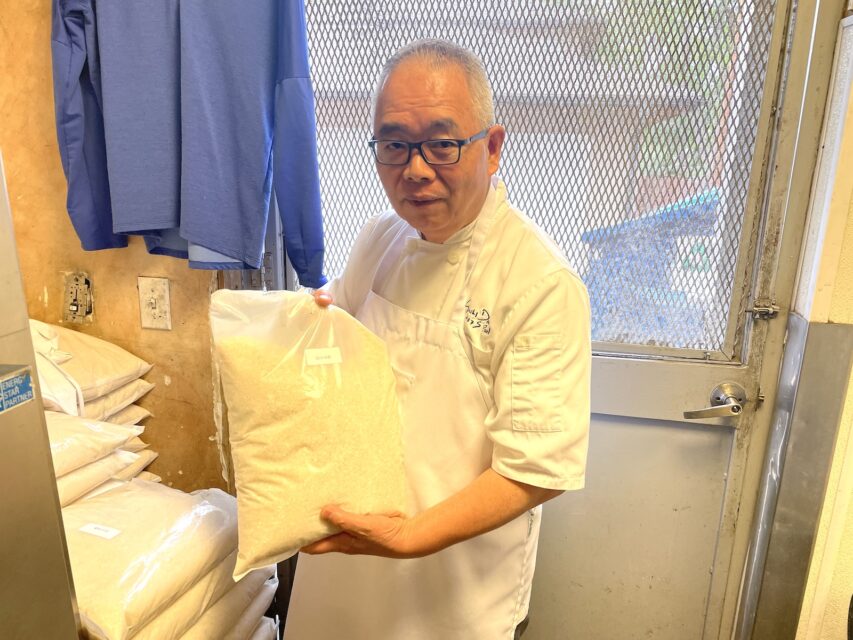
So Toshi began conferring with farmers in Japan, where the cultivation of rice from planting to harvest coincides with the rainy season. “That’s important because the soil has to be rich,” Yasu says, adding that it’s further enhanced by snowmelt from the mountains whose mineral content “deepens the flavor” as well as by organic fertilizer that supports the insect life so beneficial to soil health. After months and months of negotiation, the Kizakis received their first shipment of Japanese rice last fall, which they continue to order on a weekly basis to the tune of 40 tons a year.
That schedule is important: “The farmers harvested last year, but they didn’t polish [the rice],” Yasu says. Instead, it’s polished just before each order is shipped. “The moisture is still intact—the rice doesn’t dry up…[and] the color is different when you cook it. It’s more shiny and fluffy, and there’s a layer of flavors. It’s full of umami.”
Due to the residue left behind by the polishing process, the Den Corner chefs must gently wash the rice in cold water until the translucent grain turns white. It’s then strained and simmered in the fleet of commercial-size pressure cookers in Sushi Den’s kitchen. When the Kizakis arrived in Colorado, they discovered that boiling rice was a big issue because the elevation lowers the boiling point (and thus changes the cooking time and the rice’s hydration rate). “Toshi started thinking that to boil seven or eight pounds of rice, he needed a pressure cooker,” Yasu says. “So, he built his own. He didn’t tell anybody; I don’t know how he got the idea. Nowadays, this idea of a large pressure cooker [is common].”
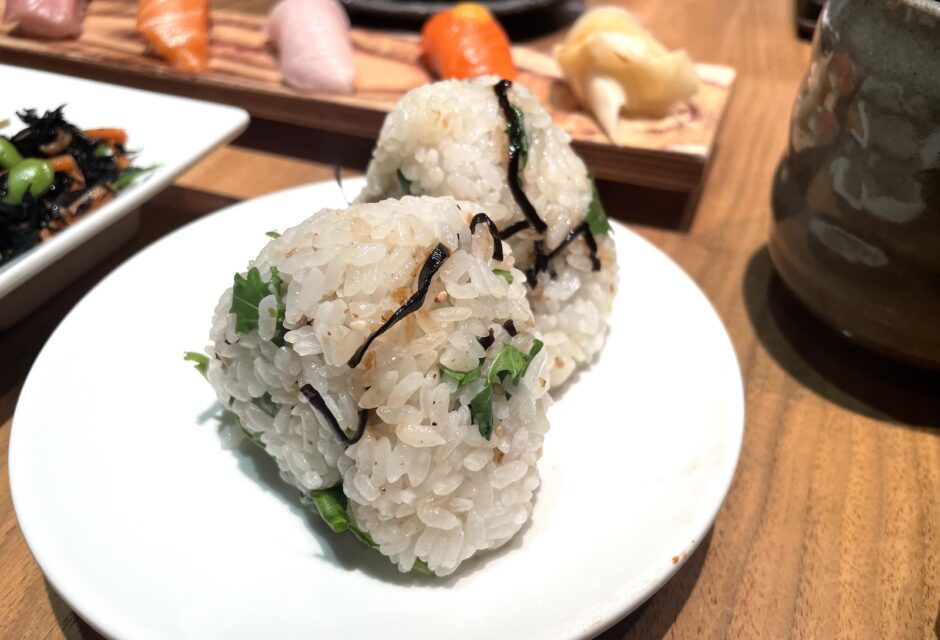
With that, Yasu served me a fabulous lunch of nigiri, rice-stuffed tofu pockets called inari, and off-menu rice balls known as onigiri. In addition to the fleshiness of the grains’ texture, I noted that their flavor was nutty and even slightly floral.
“My brother always wanted to serve the best fish and the best rice for our customers. That’s all. It started there and ends there. That’s why he always looks for new ingredients—for the customers,” Yasu says. But he wasn’t done teaching me. Mimicking his movements in the kitchen, he adds “We form rice balls with our hands. We make sushi with our hands. Our energy goes into the food. I think that this human touch is important.”
As long as Sushi Den regulars and new-found fans keep responding to that, the Kizakis have no plans to step away from their restaurants. “People often say, ‘When are you going to retire?’ My brother and I say, ‘Let’s see how far we can go,’” Yasu adds. “We found our mission, which is to serve our customers. Food often gives the biggest memories, right? We create life memories.”
Sushi Den is located at 1487 S. Pearl St., Denver, and is open for lunch and dinner Monday through Friday and for dinner on Saturday and Sunday. For a deep dive into Japanese cuisine, the Kizaki brothers are hosting their annual Summer Rooftop Party on September 1 and 2.