
The Local newsletter is your free, daily guide to life in Colorado. For locals, by locals.
In 2015, when I first learned of the Telluride Mushroom Festival, the event was already in its 35th year. I was in my first year at 5280—an eager intern in the magazine’s food and drink department hoping to land a position as a full-time staff editor. I had a budding interest in mycology (the study of fungi) and foraging and a deep desire to prove myself as a real journalist capable of exploring the food beat beyond obvious restaurant openings. I wanted to cover sustainability in Colorado in a meaningful way, to tell stories that weren’t being told about our food system, and to spotlight the people doing important work at a local level.
No one fit that description better than Katrina Blair.
As I researched and wrote about the Telluride Mushroom Festival and why Denverites should consider making the journey southwest for the educational event in 2015, her story and work struck me. Blair, an activist, gardener, land steward, chef, and holistic health educator specializing in wild plants, planned to hike solo from her home in Durango to the festival in Telluride, as she had each year since 2007, bringing almost nothing with her beyond rudimentary survival supplies.
Along the 60-mile trek, she would gather edible seeds, leaves, berries, and mushrooms to serve at her annual Wild Foods Dinner, where she and her team would prepare dishes like her signature mushroom ceviche and peach-hawthorne-serviceberry tart. She would share her philosophy on what made oft-overlooked wild foods and common weeds so compelling and how that informed her mission at her Durango nonprofit, Turtle Lake Refuge.

The more I learned about Blair’s work, the more intrigued I became. So much so that, in 2017— once I had worked my way from 5280 intern to associate food editor and was ready to tackle my first long-form feature—I pitched a profile of Blair to my editors. They accepted.
I spent months reporting the story, “Katrina Blair’s War for Weeds,” and even met Blair in person in Boulder for a foraging class she was leading. It was there that I first tasted the leaves of common chickweed—a plant featured in Blair’s book, The Wild Wisdom of Weeds: 13 Plants for Human Survival—in green juice of foraged ingredients that the class participants made by taking turns powering the instructor’s bicycle-powered blender. A few months later, I drove to Durango to see Turtle Lake Refuge’s community cafe and nearby farm, as well as some of the public parks Blair and her team were managing pesticide-free through their Bee Happy Lands program.
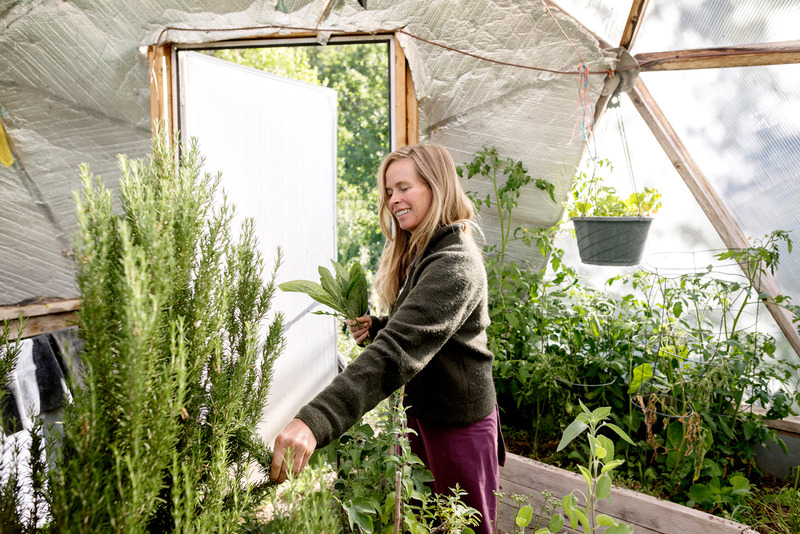
Blair was soft-spoken and kind but commanded a powerful presence. She talked and sang to her plants in the greenhouse as if they were dear friends and drank “wild,” untreated water from local streams. She and her staff served their foraged, raw, vegetarian community lunch in their cafe from 11:11 a.m. to 2:22 p.m. (the new-age “angel numbers”). The retail shelves and fridges were stocked with items like Wild Mint Magic Balls, dandelion pesto, and rosehip-infused vanilla, while the kitchen concocted house-made ferments such as purslane sauerkraut and bubbly kombucha. All ingredients were either foraged or organic and locally grown; micro-greens were sprouted on-site.
Turtle Lake had a hippie commune aesthetic and a whiff of woo-woo, but its food and products were local to southwestern Colorado and truly exceptional. In my 2017 feature on Blair, I couldn’t help but compare Turtle Lake with two-Michelin star Noma, then considered one of the world’s best restaurants. Noma’s chef, René Redzepi, also employed foraged and fermented foods. But he did so to create exclusivity and luxury, earning accolades like a Time cover with the hyperbolic headline “Gods of Food” along the way. Even nine years ago it cost nearly $300 per person to dine at the Copenhagen restaurant—and Redzepi has since been accused of physically and mentally abusing his staff for years and has relinquished his leadership role there.
Meanwhile, lunch at Turtle Lake in 2017 was a $10 to $15 suggested donation, collected via honor system. Today, it’s still just $20 for the drink, soup and salad, main entree, and dessert, which continue to be served every Tuesday and Friday year-round.
View this post on Instagram
In June of this year, I opened my Instagram app to see a post from @telluridemushroomfest: Blair had died at just 56 years old on June 5. Cancer. Her obituary in the Durango Herald noted her “unique and extraordinary life.” It seemed impossibly cruel to me that a human who had done so much for her community—people, animals, insects, plants, fungi, microbes—was gone so early.
“Katrina was one of the most talented wild foodists, naturalists, and microremediation experts I know,” says Rebecca Roberts, the Telluride Mushroom Festival’s operations manager and business development lead who also worked closely with Blair at Turtle Lake. “But she was not somebody that was talking about herself as a representative of all she’s done.”
Roberts told me that Blair knew she was nearing the end of her life and so she intentionally spent her last year making sure her work would endure, delegating and sharing knowledge so that the seeds she sowed could continue to flourish and the trails she blazed would continue to be trod. Turtle Lake Refuge is still going strong under the leadership of a newly appointed board of directors and the Telluride Mushroom Festival, now in its 46th year, will continue to hold her traditional Wild Foods Dinner. “Katrina’s real, singular wish was that the legacy and spirit of the wild foods be carried along and held,” Roberts said.
Prior to her passing, Blair worked with festival organizers to outline her vision for the continuation of the annual event. She officially passed the torch to Mila Garelle-Essam, Turtle Lake Farm’s current caretaker, who will honor Blair by hiking her route from Durango to Telluride and foraging along the way. “It’s not like a lot of hiking challenges,” Garelle-Essam says. “It’s not about distance or elevation or anything. It’s about just being out there. This is the garden and the dinner is like a bouquet of people’s stories and just holding space for Katrina.”
When it came to her annual Wild Foods Dinner, Blair truly “did it all,” Roberts says. After coming down the mountains from her trek, “she managed the volunteers, the cheffing, the plating, and putting on a show throughout the whole dinner.” This year, the Telluride Mushroom Festival team is working with chef and wellness coach Gerard LaBonté to handle the culinary vision for the dinner. LaBonté will be in charge of preparing the meal for 70 and utilizing whatever Garelle-Essam forages on her trek, plus additional wild foods collected in Telluride. LaBonté, who worked in the restaurant industry in Telluride for many years, says, “I’m excited for the challenge and honored. We have this meal that so much love and energy is being put into. It’s such an amazing message.”
While Blair’s deeply rooted community is still grieving her loss, the dinner represents the continuation—and expansion—of her legacy. “I’m so grateful to see the Wild Foods Dinner continuing with this collaborative energy,” says Rachel Gallien, a Turtle Lake Refuge board member who had been working with Blair since 2011. “We’re bringing it to a new level of professionalism, and it’s beautiful to see people captivated by these wild foods and her relationship to them.”
Fittingly, the theme of the 2026 Telluride Mushroom Festival is “rewild.” It’s a word that encapsulates Blair’s lifelong mission, one that will live on as those touched by her work continue to honor her. I still make green juice with the weeds in my pesticide-free yard the way Blair taught me—and now I tip my glass to her.
Rewild: Dining With the Wild Plants That Shaped Katrina Blair’s Journey takes place on Friday, August 14, from 5 to 8 p.m. at the Ah Haa School for the Arts Sky Deck in Telluride ($222; purchase tickets here). See a complete Telluride Mushroom Festival schedule here. Turtle Lake Refuge leadership will also hold a free Katrina Blair memorial event during the festival on Saturday, August 15, from 10:30 a.m. to noon at Elks Park in Telluride.