The Local newsletter is your free, daily guide to life in Colorado. For locals, by locals.
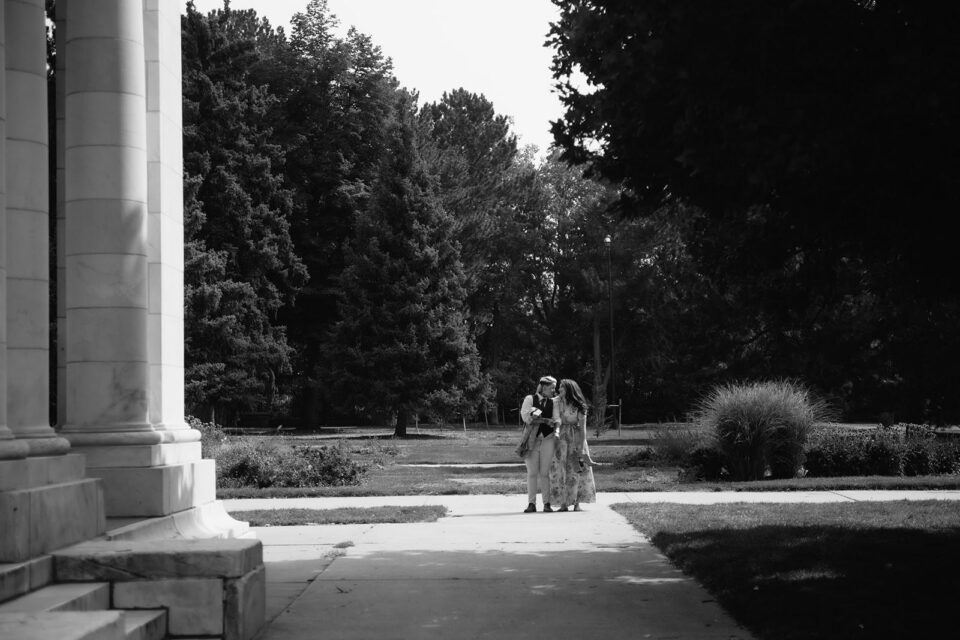
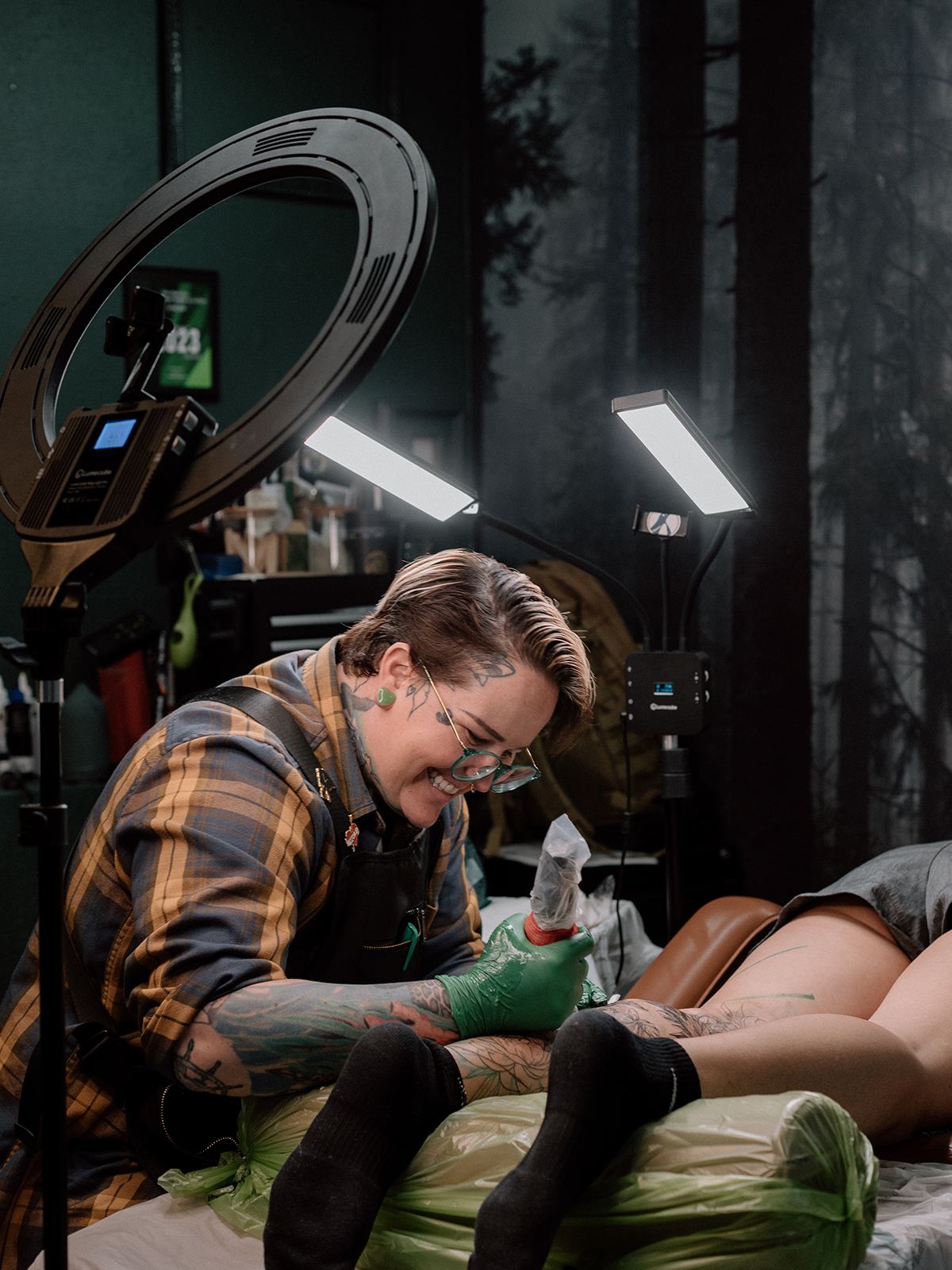
Tattoo shops often carry a certain reputation: flash-lined walls, walk-ins off the street, and most of the time, appointments that feel more transactional than intentional. But in fall of 2017, tattoo artist and Colorado native Ryane Rose, who uses “they/them” pronouns, set out to build something different. When they opened the Wolf Den on East Colfax in the Montclair neighborhood, the goal wasn’t just to ink beautiful art–it was to create a space that felt genuine and inviting. A few years later, leather artist Jess Davis joined her, and the studio grew alongside their relationship, becoming as much a love story as it was a business. They wed in 2020; Jess changed her last name.
The Wolf Den quickly carved out its place in Denver’s tattoo scene as a femme-owned, femme-forward studio, where artists and clients equally felt at home. The duo’s influence stretched beyond the art, most notably through the Rainbow Market—a queer-led vendor market at Denver Pride co-founded by Jess.

For Jess and Ryane, however, the studio’s successes were soon overshadowed by tragedy. In December 2021, a series of targeted shootings across Denver and Lakewood devastated the tattoo community, including a fatal attack at Sol Tribe Tattoo that took the lives of artists Alicia Cardenas and Alyssa Gunn-Maldonado. Ryane faced more grief when they learned that they used to work for the perpetrator (who was later killed by a Lakewood police officer) at a past walk-in tattoo studio.
All of this has prompted Ryane and Jess to close the Wolf Den and begin again in Minnesota. The St. Paul outpost opened in spring of 2025, and operations fully moved over this past June. We sat down with the couple to reflect on the parlor’s Denver chapter.
Editor’s note: The following conversation has been edited for length and clarity.
5280: What inspired you to open the Wolf Den?
Ryane Rose: I worked in multiple walk-in shops in Denver, which was probably the most common type of studio a decade ago. And working in those, you don’t know what’s walking in. You can’t really hold the space as well as you like, despite everyone’s best efforts. I could just feel the negative comments, not the kindest things being said. I could feel my clients’ bodies tense up and just be really uncomfortable. They end up taking more breaks to go outside, catch their breath.
I just hit a point when I was talking to one of my bosses. I can’t control the artists that work there, that’s fair, but they can control the environment a little bit. They can set the standards. That was the breaking point where I really wanted to find a studio that offers a safe feeling.
Jess Rose: We have moved from the word “safe” to “welcoming space.” The word “safe”’ has been weaponized, and Ryane and I want to adapt when we see things and make changes.
Ryane: I started saving up, and I would buy things I could on Amazon, because it made me feel like I was moving forward. I was kind of stuck in the studio, and there were more tattoo artists than studios, so you were lucky to have a job. It was a privilege to be working. When I got enough stuff, I started shopping for a studio. And immediately, I was inundated with people wanting to work with me. [It felt like] imposter syndrome—This can’t be really happening. I stepped into a leadership role kind of unknowingly, and it really pushed me as a human, as a creative, as a queer person in the community, saying, OK, now I am on the map, and what am I representing?
When you opened the studio, what kind of space did you hope to create—for yourselves, your artists, and your clients?
Jess: When Ryane was tattooing, before they had their own space, people walked around flinging guns. That actually happened.
Ryane: If you worked in a tattoo shop, you were probably gonna get shot. That was kind of what you signed up for, which is insane, because we’re doing beautiful flowers and bunnies and creatures, and then there’s someone with a Glock. It was so normal.
I think my nervous system [had] to reset in my own space. That doesn’t have to be normal. And now these younger artists don’t even understand that part of it, and it’s amazing. I never thought in my career I would see that. There are so many shops popping up every day that are queer forward, all female. Never, never in a million years [did I think I would see that].
Can you talk about the community that formed around the space—what made it special?
Ryane: One time my door frame was a piece of crap, and I hear, bam, bam, bam, bam, bam, and it’s one of my clients from years prior with a hammer. He goes, “I drive by it every day. I can’t handle it. I need to fix it. I only have this amount of time before I pick up my kid and I just gotta fix it.” He rebuilt the door frame and painted it, without being asked. He said he couldn’t let this be the first thing people see, because we’re his shop. Just beautiful things that happen over and over again. Micro moments, major moments, people crying in my chair, just sharing wonderful things here. I’m so grateful, because it really gave me so many tools and so much love to move forward with our culture here, up [in Minnesota]. Denver taught me how to steer in that. I just want to be ever so grateful.
Jess: There are so many people that come into our space that remind us that humans are so interesting and that so many people are carrying a lot. We both have been profoundly impacted by everyone’s stories that they’ve shared with us. We have lovely clients that are so sweet, and they bring gifts, and you’re like, What? Wow.
Ryane: I’ve watched people grow up here. I have this client who started coming in as a freshman in college when he was first old enough to get tattooed, and he was a part of a violent hate crime. He was scared to come out, but came out to me while I was tattooing him. He’d never told anybody. I literally watched this guy grow up, and he’s such a beautiful, mature adult that is a pillar in the queer community.
Why is now the right time to leave Denver and close this chapter?
Ryane: I don’t want to ever hang on to something longer than it needs to be. Everything’s kind of pointing to Minnesota. Denver’s my home. I’m from here, most of my family is here, and so I’ll always be back. But even talking to my mom about it, she [feels] like something is calling me, and life is too short not to answer it and see what happens. And it’s hard to leave here, but it’s pulling both of us, and that’s too crazy to ignore.
You shared that 2021 changed everything. For people who might not be familiar with the story, can you share what happened?
Ryane: Years and years ago, I worked at this walk-in studio. I wanted to gain experience to get into the one female-owned business that was in Denver at the time, Sol Tribe, and that in my opinion was the shop. The best artists were there. It looked like it was such a beautiful community, and it was run by a woman, and I’ve never seen that representation before. I went in and applied, and was told I need more experience. I got a different job and said I was going to do it for a year, then circle back with Sol Tribe.
My new boss started going from the fun uncle when he interviewed me, to really scary and really aggressive, showing up in military clothing and showing up with a gun on his hip. I left, and he was so angry that I left. I moved on to a different walk-in studio, and he would call every day, saying “I’m gonna kill you. I’m gonna shoot you with my shotgun.” Every day, without fail, he said he was going to kill me. Months later, the calls stopped. I hadn’t heard from him for years.
I start the Wolf Den, the pandemic happens. We’re getting through that. Jess and I went on a vacation to Minnesota to spend Christmas with her family. While there, my phone starts blowing up, and it’s all my friends from Florida, Boston, people here, saying, “Oh my God, are you OK?” What are you talking about? “A female owner was just killed in Denver. We’re seeing it live on TV.”
My alarm was set off earlier that day at the shop. Someone tried to kick in my door, and you can see on the camera a van speeding off. I know that van. It all started to come together that it was my old boss, who made a hit list of all the people he thinks have wronged him. He basically went down the list and got almost every single person, but he didn’t get me, because I wasn’t here. I think I’m the only survivor on the list.
One by one, every shop involved has closed. When Sol Tribe closed, it was devastating, but I can’t blame them. I can’t imagine going to work every day where it all happened, and I decided it’s time for us. Every time someone knocks really hard it really gets me, and that’s a sign that I really need to heal. How many people have I made upset? [That man] was upset with me for years, and that festered and festered. He was obviously mentally unwell to where he made a list to kill us. I’ve been tattooing for so many years, it’s inevitable someone’s going to be upset. You can’t please everybody, so how many of those people are here? How many are going to act on it? That’s something I need to work on, and it doesn’t feel like I need to be here for that. I’m not healing here.
What have you learned from running the Wolf Den?
Ryane: We’ve always hung in there. And we are always making sure the women that work here are thriving, because it is a tough city, and if you don’t have a partner, you’re paying for everything by yourself. How can they be self-sufficient and feel comfortable? Every woman that has ever left our shop has left a better artist, more financially stable, and more grounded. I am the proudest of that.
But with that came a cost; we should have poured into ourselves a little more because we gave everything to everyone else. That’s a hard, hard lesson, and one you don’t need to learn twice. So I definitely give that advice to small-business owners, that oxygen mask. We ran out of oxygen, for a little bit. And that’s when we started to realize that this can be done better, for ourselves.
Your message encourages people to “do what is right for you.” What did it take for you to finally follow that advice yourselves?
Jess: Along with everything else we’ve been juggling, my mom had a pretty big health crisis, and it completely tore me apart. That moment was the biggest slap in the face to make sure that I’m doing what I need to do for myself.
Ryane: Her parents are small-business owners. Working to the bone, [she] wasn’t putting herself first. It all hit her, and she ended up in the hospital. I don’t know what better lesson we can get from this. We got to figure this out. Life is so short. We have to break this cycle. We were already kind of pivoting. And then I was like, All right, it’s time.
What would you want to say to Denver as you close this chapter?
Ryane: I’m so grateful that I got to do it in my home state and have so much support. I’m hoping we left an impact the way I wanted it to. And by seeing all these other women running studios it’s like, Wow. I think I was a part of that. It was a small, small aspect. But the women that were fighting way before me made it so I could do it.
We have such a loyal following of amazing humans. If I could do a picturesque ending in Denver, it would be in the form of a love letter and a thank you; a bittersweet love letter. How beautiful, how romantic. I wanted to give that while I was here, and now we’re ready to grow into a bigger pot.